
In previous interview with female singer Đinh Hương, we have seen a part of planning, production processes of the album Black Magic Woman. This time, we will share the points of view, considerations of sound engineer Gareth Thomson while he mixed, mastered all 12 songs of this great sounding album.
In order to make an objective review about sound quality and artistic mixing decisions of the album, we listened critically non-stop from the first to the last second. For us, Black Magic Woman easily ranks among the top in terms of sound quality among Vietnamese music albums released in recent years.
The sound is balanced, pleasant, clear and each song has its own characters in the way it is handled. The mixes translate well to the different sound systems I have tested from headphones, in-ear, Bluetooth speakers and the car. The balance is maintained well, there is no phenomenon of sudden changes in the mix’s timbre or any instrument popping out of the mix unexpectedly when changing the playback medium.
Switching back and forth between the album and some of my reference tracks (level matched, of course), we did not notice the same quality gap I’ve experienced with some of other recent Vietnamese hits. Of course, there is slight gap. However, we think it is more about personal preferences. This is a compliment and a testament to the fact that: When you have the right attitude and care deeply enough about sound quality, you can create good products that aren’t far off the world-class standard.
One thing we like about the way the sound engineer handled this album: Good micro-dynamics & macro-dynamics. We don’t feel like the sound is squashed very much. The sound engineer worked hard on the automation of effects, vocal riding, other instruments, subtle sound effects to ensure everything sounds clearer, more interesting while still maintaining the natural, pleasant, cohesive feel of the overall mix. Look into transitions between parts of the song, the sound engineer created a good contrast in space, energy, thickness and sound intensity. As a result, the listeners’ emotion is lifted through different levels and shades according to different parts of the songs.
We know. We talked too much. Let’s get into the interview right now!

Why did you decide to handle both the mixing and mastering phases instead of outsourcing the mastering to a third party to take advantage of a completely fresh set of ears on the mix?
That’s a great question. Normally, it’s a wise idea to have a separate mastering engineer involved in the project—it can be a great way to bring fresh objectivity after you’ve been deep in the mix for so long. But for this project, and for a lot of the work I do now (currently around 50% of the records I mix), I’ve found myself handling both.
Mastering has become a big part of my work—these days, over half of my projects are mastering-only. It’s a skill I’ve invested a lot of time into developing, learning from some great engineers along the way. I’ve developed a real love for the process, and artists have thankfully been really happy with the results that I deliver.
To be honest, I’ve also found it challenging to find mastering engineers within my price range that I fully trust. When an artist has the budget, I often recommend taking the master to someone at Sterling or Metropolis—engineers like Chris Gehringer, Randy Merrill, or Stuart Hawkes. But for many artists, that level isn’t always affordable, and I’d rather take on the responsibility myself than risk the record not translating the way it should.
That said, mastering your own mixes comes with its own challenges. You have to be hyper-aware of your biases. As well as constantly comparing and challenging myself to improve, I’ve had some incredible mentors over the years who’ve helped refine my ear and given me honest feedback, which has been invaluable. It’s also a great idea to create space between mixing and mastering. This album came together over two to three years, so by the time we were finishing, I was able to approach the mastering with fresh ears and a healthy amount of objectivity.
How did you ensure the overall sound tone of the album remained consistent while still highlighting the unique character of each track?
A lot of the consistency across the album happens naturally—Hương’s voice, vision, and musical instincts are present throughout, which already ties everything together. Plus, many of the songs were produced by the same team, and I handled all the mixing and mastering, so there’s a shared sonic thread just from the personnel involved.
From a mixing perspective, there are a few practical approaches to maintain continuity. When I find a vocal chain that works well with Hương’s voice, I’ll often carry that across multiple tracks as a starting point, then shape it for what each song calls for. Same goes for verbs, delays, and mix bus processing. I’ll change things as I go, but it’s good to have a familiar starting point. I’ll also drop the previously completed mixes from the album into my session to compare as references too, just to make sure we’re in the same sonic neighborhood.
That said, consistency isn’t really my main focus. What matters more is that each song speaks in the most compelling way possible. If a track is calling for a completely different approach, I’ll follow that instinct. I’d rather have an album where every song feels right in its own way than one that’s sonically uniform but emotionally flat.
The tools and shared knowledge we have now make technical excellence much easier to achieve, so the engineers and producers who are going to stand out are the ones with unique creative intuition and great ideas. What separates work that actually moves people is creativity – knowing when and how to artfully break rules, when to preserve imperfections that give the music character, when to push something into new territory. That’s where the exciting part of mixing is for me.
Track number 2 – The Cathedral of Love, the background music is very complex with multiple layers of synth, guitar, and effects. It has a heavily textured and crunchy sound. Could you share with Mix Magazine’s readers details about these layers and how you processed them?
Many of the distortion choices for this song were created in the production, and I worked off wet stems, so credit has to go to Yahy for many of the cool textures and crunch. For example, the synths and low horns in drop section I left almost untouched as they were already heavily processed. The only thing I felt they needed to fit into the mix was a little bit of widening with the bx_control, some resonances control with Soothe 2, and then I made sure they weren’t getting in the way of the vocal and kick with some sidechain compression using Fabfilter ProC2 and Wavesfactory Trackspacer.
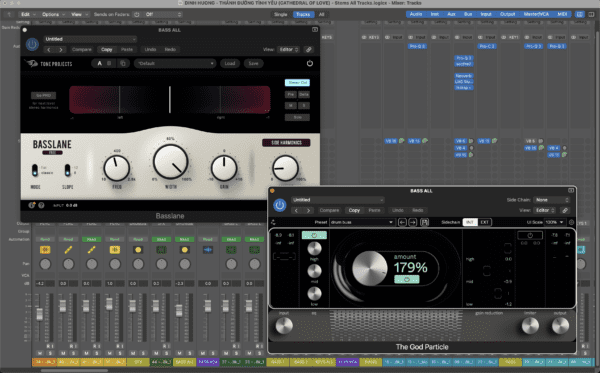
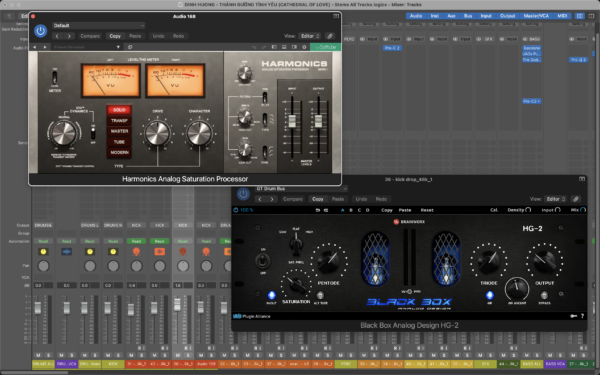
For the drums, I gave some more saturation using Blackbox HG-2 and Softube Harmonics. On the bass I used Tone Projects Basslane, which brings saturation to the sides for a widening effect, as well as The God Particle dialed up to 179% for saturation, widening, and some multi-band compression.
I also used UAD Studer tape emulation throughout the mix on a few elements for some subtle colour, glue and saturation. On the mixbuss I used both the Oxford Inflator and Metric Halo MB MixHead for some glue and density on the overall mix.
Track 7 – Black Magic Woman: This is the track that impressed me the most in the entire album in terms of musical aspect. With the lead vocal, Đinh Hương changes her singing style multiple times, causing the character of the voice to vary significantly throughout the track. How did you process the lead vocal? Did you use separate Vocal FX Chains for each singing style?
Getting a consistent vocal with such a dynamic performance is always an interesting challenge — I generally work with a multi-staged approach. I firstly organized the vocals into 2 main auxiliary tracks, “Soft” and “Hard” (just shorthand terms for the main two characters of Huong’s voice on this song). Each of those two aux tracks had some broad EQ, multiband compression, saturation, compression, and sends to reverbs and delays.
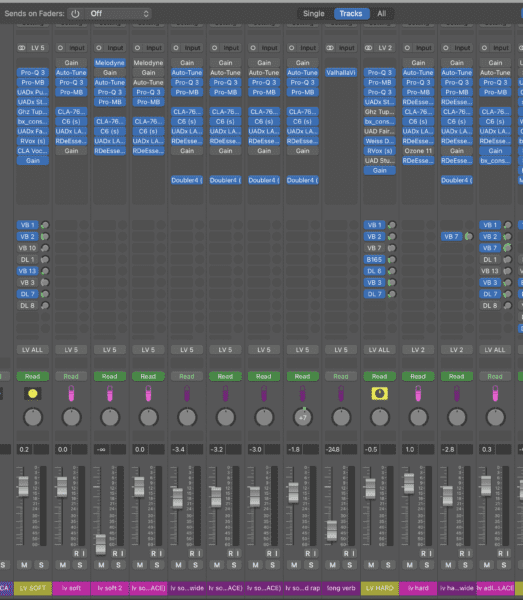
Then within each aux group, I had the vocal split into several ‘sub-tracks’, which allowed me to dial more differences between each moment. Those sub-tracks usually had some Antares Autotune, Fabfilter EQ, CLA-76 and UAD LA2A compression, Fabfilter ProMB and Waves C6 multiband compression, and Waves RDesser. Some tracks also had widening using doublers.
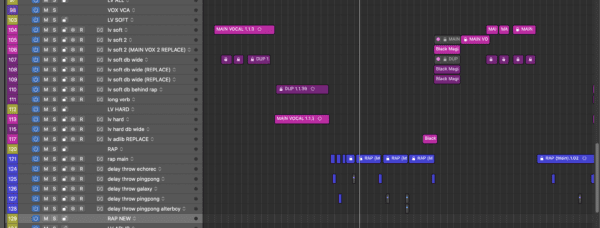
There’s also some automation involved, tweaking the gain, autotune, EQ, reverbs, and fader levels, moment to moment.
Track 11 – God Bless You, one of my favorite tracks on the album—I love the way you mixed the background vocals. The layers of background vocals weave together with the lead vocals and ad- libs, yet they still stand out just right over a very dense instrumental, especially in the final chorus. How did you achieve that?
Thank you very much. This was a massive song to mix — it had over 220 layers, including over 120 backing vocals.
To get the vocals to sit over the top of the mix in the final chorus, I firstly made sure they were really dynamically consistent and feeling loud, with some heavy-handed compression (up to -12db on the CLA76, -2db with UAD LA2A, and -2db with SSL channel strip compression). I also used some distortion with Decapitator to drive them harder.
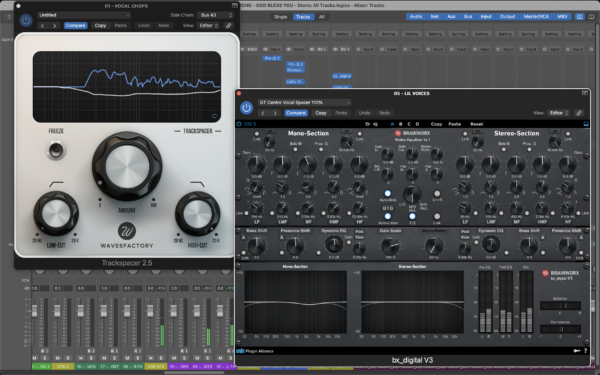
Then throughout the mix if I feel a certain element is crowding up the same frequency range as the lead vocal (such as backing vocals, the guitar solo, synths), I’ll use some mid-side EQ to clear some space in the mid channel where the vocal sits at around 2.5k. I’ll then also use Wavesfactory Trackspacer as a band-specific sidechain compressor to allow the vocal to cut through clearly.
I noticed that you chose a smooth, natural vocal style instead of the sharp, dense modern pop vocal approach, and I agree with that. However, I feel that the vocal sound still comes off a bit too safe, and there are many moments where it could be more experimental or “wild” with distortion, delay, reverb… especially in an album with an electro-pop vibe like this. What do you think about that?
That’s a thoughtful observation. We explored quite a few approaches over the course of the record. Hương had a strong vision for how she wanted her voice to sound, and the direction we landed on was what felt right to us — generally warmer, dynamic, and natural, with considered reverb choices.
I’m definitely not opposed to heavily effected and bright vocals — I’ve done plenty of wild vocal processing on other projects and enjoy going in that direction when the music calls for it. But for this collection of songs, we felt this natural direction allowed Hương’s voice to speak for itself and connect more intimately with the listeners.
That said, there were definitely moments where we embraced more creative treatments — like the vocal breakdown in “God Bless You” where I filtered the vocal stacks and played with the tempo, or the textured delay throws throughout ‘Black Magic Woman’ and ‘Masterpiece’.
One thing that’s fascinating about creative work like mixing is that it’s never really “finished.” It’s a snapshot of your inspiration and intuition at a specific moment—the result of countless decisions and creative impulses that align in a particular way. Mixed on a different day or in a different year, the record could have sounded entirely different. Who knows, maybe in the future we’ll work together again and find ourselves drawn to a completely different approach.
The final question, you have worked with many international artists. What is the most special aspect that impressed you during the mixing & mastering process of the Black Magic Woman album for a female artist from Vietnam like Đinh Hương?
Dinh Huong had an unusually strong and clear vision of her album concept — before we met, she already had moodboards of the themes, visuals, the artwork, the genres, a calendar and timeline of the stages of development. She was incredibly well organized. She was inspired by a unique melting pot of influences— she’s drawing from a wide array of genres. Drawing from the tradition and legacy of Vietnamese and Asian pop music, but also inspired by artists from many genres in the West — electronic music, funk, RnB, gospel, pop. She blends it into a unique blend that’s her own voice, and her own story, not just a copy of Western styles.

She’s a natural leader who expertly coordinates her team, managing everything from schedules and communication to finances and creative direction. She’s not afraid to have difficult conversations when necessary, while also openly showing appreciation and respect. I was impressed by how she balanced creative freedom with vision — knowing when to trust her team to explore and when to step in to guide the direction. She has a remarkable work ethic — many of the mixing sessions she turned up exhausted after working all night long on various aspects of the project, but she always brought her A-game and was 100% committed to doing good work in the sessions no matter what.
Thank you very much!

Chuyên gia âm thanh, tác giả sách
Nguyễn Thái Hà có hơn 20 năm kinh nghiệm trong lĩnh vực âm thanh. Anh thích nghiên cứu về tất cả các vấn đề xung quanh âm thanh để tìm ra các phương pháp tư duy tốt, quy trình làm việc hiệu quả cho kỹ sư âm thanh, nghệ sĩ, và người nghe nhạc đại chúng.